Respelling vs IPA: The Easier Option If Symbols Confuse You
Learn what pronunciation respelling is, how it differs from IPA, and when an easy-to-read pronunciation guide is more useful than phonetic symbols.
Pronunciation respelling is a way of showing how a word sounds using ordinary, familiar letters instead of special symbols. It's easier to read than IPA at a glance, but less precise, because English letters can stand for more than one sound.
You look up an unfamiliar word, and next to it you see something that isn't quite the normal spelling: a rewritten version built from letter combinations you already know how to say. That's pronunciation respelling, and it's the pronunciation system most people encounter first, often without knowing it has a name.
This guide explains what pronunciation respelling is, how it works, and how it compares to the International Phonetic Alphabet (IPA), with real examples of both, so you can decide which system fits what you're trying to do.
What Is Pronunciation Respelling?
Pronunciation respelling rewrites a word using common English letter patterns that approximate its sounds. Instead of learning a new symbol set, you lean on patterns you already recognize from everyday reading. Think of the way "oo" usually suggests one familiar vowel sound, or "sh" reliably suggests another consonant.
Here's what that looks like in practice. Take a sentence full of words whose spelling badly misrepresents its sound:
Written: The colonel will schedule a meeting on Wednesday.
Respelled: thuh kurnuhl wil skejool uh meeting ahn wenzday .
No symbols, no training. You can read it out loud right now. Notice what the respelling quietly fixed: colonel has no "r" sound where its spelling suggests one and one where it doesn't (kurnuhl), and Wednesday loses the "d" that was never pronounced anyway (wenzday).
Dictionaries, language textbooks, journalism style guides, and name-pronunciation guides have used respelling for exactly this reason: it works instantly for readers with no phonetic training. One thing to understand early, though: there is no single universal respelling standard. Different dictionaries and publishers each maintain their own conventions, and the Wikipedia overview of pronunciation respelling for English documents more than a dozen distinct systems used by major dictionaries alone. That flexibility is part of why respelling is approachable. It is also why it can't match IPA's precision.
Pronunciation Respelling vs IPA
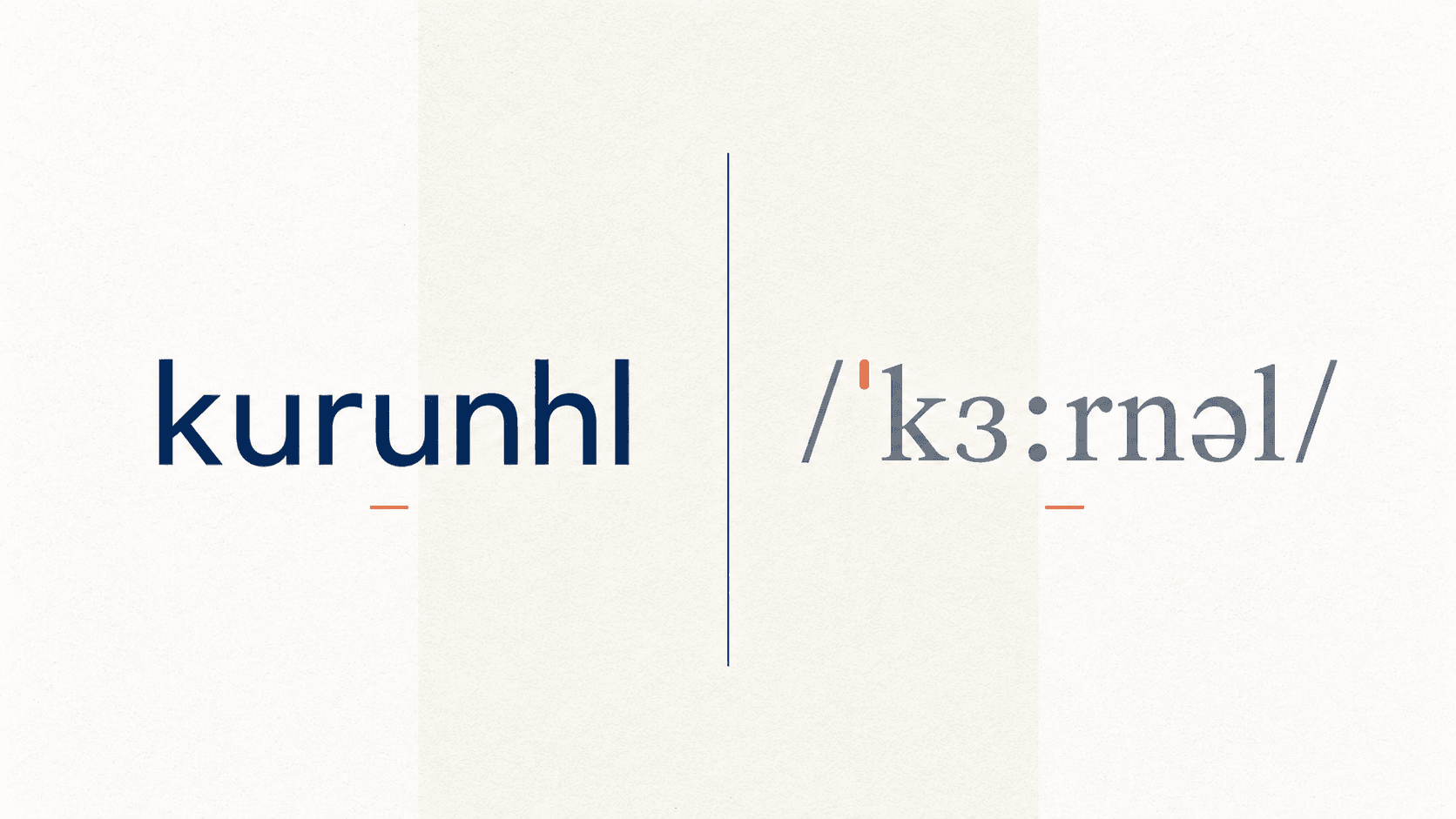
The two systems solve the same problem from opposite directions. The problem: English spelling doesn't reliably tell you how a word sounds. Respelling optimizes for readability; IPA optimizes for precision.
Compare the two side by side on the trickiest words from the sentence above:
| Word | Respelling | Dictionary IPA (US) |
|---|---|---|
| colonel | kurnuhl | /ˈkɜːrnəl/ |
| schedule | skejool | /ˈskedʒuːl/ |
| Wednesday | wenzday | /ˈwenzdeɪ/ |
Both columns tell you how the words sound, but they trade off differently:
| Pronunciation Respelling | IPA | |
|---|---|---|
| Readability | Instant for any English reader | Requires learning the symbol set |
| Precision | Approximate; one pattern can suggest several sounds | Uses standardized symbols to represent speech sounds more precisely than ordinary spelling |
| Consistency | Varies by publisher; no universal standard | Standardized by the International Phonetic Association |
| Dialect handling | Usually implies one "default" accent | Can notate American, British, and other accents distinctly |
| Best audience | General readers, beginners, quick lookups | Learners, teachers, linguists, precision work |
The dialect row matters more than it looks: schedule is a word where American /ˈskedʒuːl/ and British /ˈʃedjuːl/ genuinely diverge. IPA can show you both, explicitly labeled. A respelling like skejool commits to one reading without telling you it did.
Neither system is universally better. They're tools for different jobs. Plenty of people use both, reaching for respelling when speed matters and IPA when accuracy does.
How Pronunciation Respelling Works
Respelling works by mapping each sound in a word to a letter combination that most English readers already associate with that sound. Long vowels, short vowels, and common consonant clusters each get a conventional spelling pattern, and the word is rebuilt from those patterns.
Why is this necessary at all? Because English spelling and English sound have drifted hopelessly apart. The language has roughly 44 sounds but only 26 letters to spell them with. One sentence is enough to see the problem:
Written: We fought through enough tough decisions.
Respelled: wee fawt throo eenuhf tuhf disizhuhnz .
The same four letters, ough, are pronounced three different ways in that one sentence: aw in fought, oo in through, and uhf in enough and tough. The spelling gives you no warning; the respelling makes each one explicit.
Respelling done at the sentence level can also capture things a word-by-word lookup structurally cannot. Look at what happens to the word the in these two real outputs:
kuud yoo reepeet **thuh** pruhnuhnseeayshuhn ?
ahr ahntruhpruhnur diskuhst **thee** uhseetuhminuhfuhn lawnch .
Same word, two respellings: thuh before a consonant sound, thee before a vowel sound. That's not an inconsistency; it's how fluent speakers actually pronounce the, and it only becomes visible when the whole sentence is processed together. A single-word dictionary entry has to pick one and hide the rule.
There's still a catch, and it's the fundamental trade-off: respelling patterns run through the reader's own accent. Two readers with different accents can interpret the same respelling differently, because their reference points for "how that combination sounds" aren't the same. Respelling borrows the reader's existing intuitions, which makes it instantly readable. But those intuitions vary from reader to reader, which makes it imprecise. IPA avoids the problem by defining every symbol independently of any spelling habits, at the cost of a learning curve.
When Respelling Is Useful
Respelling is the right tool more often than phonetics enthusiasts tend to admit. It shines when:
- You're a beginner who can't read IPA yet. Respelling gives you a usable pronunciation cue today, with zero study required. It's a perfectly good on-ramp.
- You need a fast check on an unfamiliar word. Encountering a new term mid-task, you often just need a "close enough" reading, not a phonetic analysis.
- You're preparing names or professional vocabulary for a presentation or meeting. A speaker rehearsing a line like "Our entrepreneur discussed the acetaminophen launch" can read
ahntruhpruhnuranduhseetuhminuhfuhnoff the page immediately. No symbol chart is required for two of the most commonly fumbled word types in professional speech. - You're a teacher giving students a first pronunciation cue. An accessible approximation can get a class saying a word immediately, with precise IPA introduced later.
When IPA Is the Better Choice
There are jobs respelling simply can't do, and it's worth knowing where that line sits:
- Precise sound distinctions. Minimal pairs and subtle vowel contrasts need one-symbol-one-sound notation; approximations blur exactly the differences you're trying to see.
- Language teaching and linguistics. Serious pronunciation study, accent work, and any linguistic analysis are built on IPA.
- Comparing American and British pronunciation. As the schedule example showed, IPA can represent both accents explicitly side by side; respelling generally commits to one unstated accent.
- Escaping English spelling ambiguity entirely. Respelling still runs on English spelling habits, the very system causing the confusion. IPA steps outside it completely.
For those cases, you'll want to generate standard dictionary IPA instead, and if the symbols are new to you, our beginner's guide to IPA covers how to read them from zero.
How to Use IPAtranslator's Respelling Generator
If you want to see respelling on your own words rather than these examples:
- Open IPAtranslator and switch the display to respelling.
- Paste a word, a phrase, or a longer passage. Every example in this article is unedited output from this tool.
- Read the respelled result using your normal English reading instincts. That's the entire point of the system.
That's it: no symbol chart, no setup. And when a respelling leaves you unsure (which happens, given the accent ambiguity discussed above), switching the same text over to IPA is the natural next step for a definitive answer.
Common Respelling Mistakes
- Treating respelling as a universal notation system. It isn't one system; it's a family of publisher-specific conventions. Don't assume a respelling from one dictionary follows the same rules as another.
- Assuming capital letters always mark stress. Some publications use capitalization that way; others don't. You'll notice the outputs in this article are entirely lowercase. There is no cross-system rule, so don't read stress into formatting unless the specific source defines it.
- Adding hyphens or syllable boundaries the source didn't produce. The outputs above are written as continuous words (
pruhnuhnseeayshuhn, not "pruh-nuhn-see-ay-shuhn"). Inserting your own breaks can change how a respelling is read, so treat the output as-is. - Using respelling for precision work. If the task involves fine sound distinctions (accent comparison, minimal pairs, linguistic notation), respelling is the wrong tool, however convenient it is.
A related point that trips people up: different dictionaries also disagree with each other about pronunciation notation, even within IPA. Our guide to why pronunciation systems differ unpacks where those inconsistencies come from.
Frequently Asked Questions
Pronunciation respelling is a way of writing how a word sounds using familiar English letter combinations instead of phonetic symbols; for example, "colonel" becomes kurnuhl. It's designed to be readable instantly by anyone who reads English, at the cost of some precision.
The terms are often used interchangeably in casual use. Strictly, "phonetic spelling" sometimes refers to symbol-based notation like IPA, while respelling specifically means rewriting words with ordinary letters. Respelling is therefore the more precise name for the familiar-letters approach.
Easier to read, yes: it requires no learning at all, since it reuses spelling patterns you already know. But it's less exact, and different readers can interpret the same respelling differently depending on their accent.
Not reliably. A respelling commits to one reading without labeling which accent it reflects. "Schedule" respelled as skejool reflects the American pronunciation, while IPA can show US /ˈskedʒuːl/ and UK /ˈʃedjuːl/ side by side, explicitly labeled.
Learn IPA when you need precision: distinguishing similar sounds, studying pronunciation seriously, comparing accents, or teaching. If you only need quick, approximate readings of unfamiliar words, respelling may be all you ever need.
Read It Now, Refine It Later
Pronunciation respelling gives you an instant, no-training-required way to read how a word sounds. IPA gives you the precision to go further when approximation isn't enough. The practical move is knowing which one the moment calls for.
For a readable answer right now, open IPAtranslator and use the respelling display; when you're ready for precise notation, the IPA view is one click away.
Author

Categories
More Posts
Why Dictionaries Disagree on IPA: From Jones to Wells
Why do Oxford and Cambridge transcribe the same English word differently? Explore the history of IPA, the Jones-Gimson-Wells lineage, and the Upton debate.
Hard Tongue Twisters in English (With IPA Breakdowns)
Hard tongue twisters in English with full IPA: R, S, TH, and L sound drills, plus what fast speech does to each phrase. Free to try, with audio playback.
Connected Speech: Rules, Examples, and Why Word-by-Word Fails
Connected speech patterns explained with IPA — weak forms, linking, assimilation, elision, the flap — and practice steps for hearing and producing each one.
Newsletter
Join the community
Subscribe for English pronunciation tips and product updates