LogoIPAtranslator
  • Pricing
  • Blog

Why IPAtranslator

  • No credit card required to start
  • Standard dictionary IPA is always free
  • Cancel or change plans anytime from your billing page
  • Questions? support@ipatranslator.com
LogoIPAtranslator

Translate English text into standard and spoken IPA.

Tools
  • IPA Translator
  • English to IPA Converter
  • Phonetic Spelling Generator
  • Pronunciation Practice
  • Type IPA
  • Features
  • Pricing
  • FAQ
Company
  • About
  • Blog
  • Contact
Legal
  • Cookie Policy
  • Privacy Policy
  • Terms of Service
  • Refund Policy
© 2026 IPAtranslator. All Rights Reserved.

English to IPA Converter for Standard Pronunciation

This English to IPA converter creates a word-by-word IPA baseline before weak forms, linking, or other connected-speech changes are applied.

Dictionary-form IPA, free without an account.

Type or paste English text below.

English Text Input

Press Enter to transcribe, Shift+Enter for new line

0 / 500 characters
Edit

IPA Transcription

IPA symbols will appear here

Standard IPA transcription will appear here...
This English to IPA converter turns recognized words, sentences, and passages into standard dictionary IPA, giving you citation-form American or British pronunciation free without an account.

Start with the Dictionary Form of Each Word

Standard IPA shows the careful citation form used as a pronunciation baseline.

Dictionary-Form Pronunciation

See citation forms for recognized words before weak forms, linking, or conversational reductions are applied.

American and British IPA

Switch between US and UK dictionary pronunciation without changing tools.

Words, Sentences, and Passages

Visitors can paste up to 500 characters; signed-in users can paste up to 10,000 while keeping the original sentence structure and punctuation in the result.
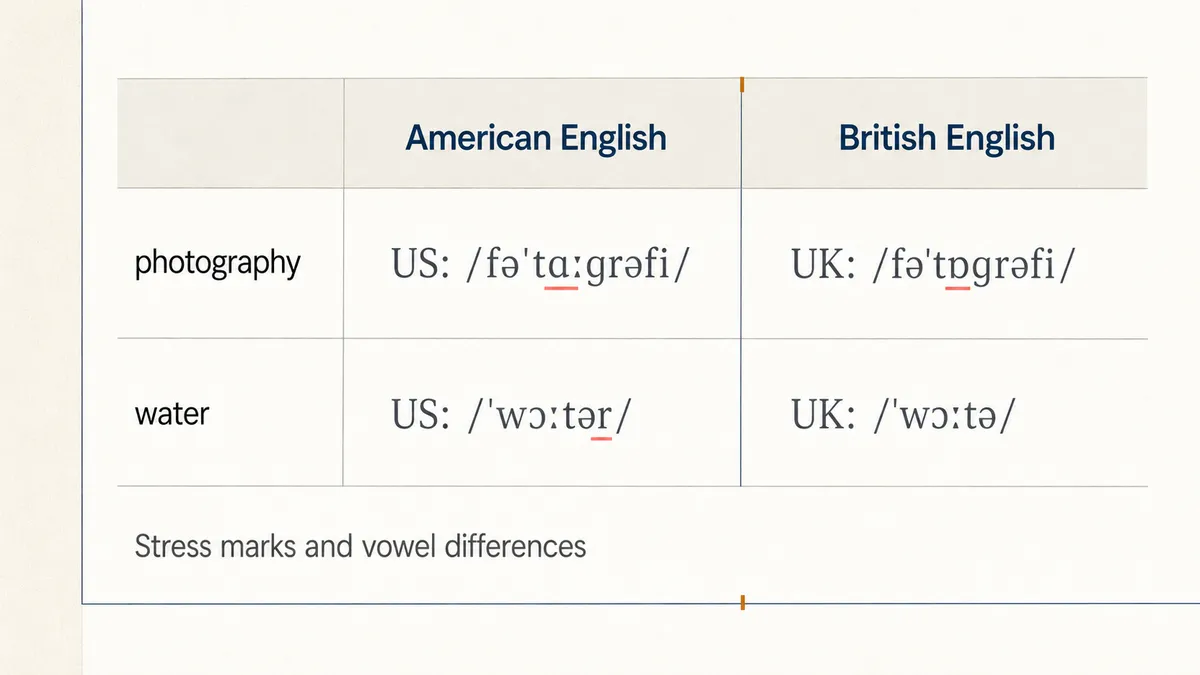
American and British IPA comparison for photography and water

Convert English Text to Standard IPA

Get dictionary-based IPA for recognized words, free without an account.

Try the English to IPA Converter

How to Use the English to IPA Converter

Go from written English to dictionary-form pronunciation in three steps.

1

Paste Your English Text

Enter a word, sentence, or longer passage.

2

Choose US or UK English

Select the dialect whose standard pronunciation you want to study.

3

Click Show IPA

Generate citation-form IPA for recognized words, then copy the result for notes, lessons, or reference.

Common IPA Symbols in the Converter's Output

A few symbols account for most of what you will read in an English transcription.

ˈ

Primary stress — placed before the stressed syllable, as in /ˈrɛkɔːrd/ (noun) vs /rɪˈkɔːrd/ (verb).

ə

Schwa — the relaxed vowel in the first syllable of about, and the most frequent vowel sound in English.

ː

Length mark — the vowel before it is long, as in /siː/ for see.

θ / ð

The two th sounds: quiet /θ/ as in think, voiced /ð/ as in this.

ʃ / ʒ

The sh sound in ship and its voiced partner in vision.

ŋ

The ng sound at the end of sing — one sound, not n plus g.

Standard IPA Questions

What dictionary-form transcription shows and what it leaves for spoken IPA.

Standard IPA, also called citation-form or dictionary IPA, represents a word's careful pronunciation in isolation. It is the form commonly shown in learner dictionaries. The converter also adjusts common articles such as a, an, and the to match the sound that follows.

Standard IPA keeps recognized words in their dictionary forms. Spoken IPA also shows weak forms, linking, and reductions that can appear when words are used together.

Yes. Paste a sentence or longer passage to preserve its structure and generate dictionary-based IPA for recognized words.

Yes. Use the dialect control above the editor to switch between American and British dictionary IPA.

Yes. Standard dictionary IPA is free without an account. Visitors can also try Spoken IPA with 10 one-time credits; sign up for more when those run out.

The tool uses standard IPA notation commonly found in learner dictionaries. Symbols can vary by dictionary, dialect, and editorial convention, so individual entries may differ between sources.

The ˈ symbol sits before the stressed syllable of a word. Stress placement can change meaning — /ˈrɛkɔːrd/ is the noun record, while /rɪˈkɔːrd/ is the verb — so reading the stress mark is often the fastest fix for a mispronounced word.

Get the Dictionary Pronunciation of a Complete Passage

Paste your text and generate standard IPA for recognized words.

Show Standard IPA