Word-by-Word IPA Can Sound Too Careful
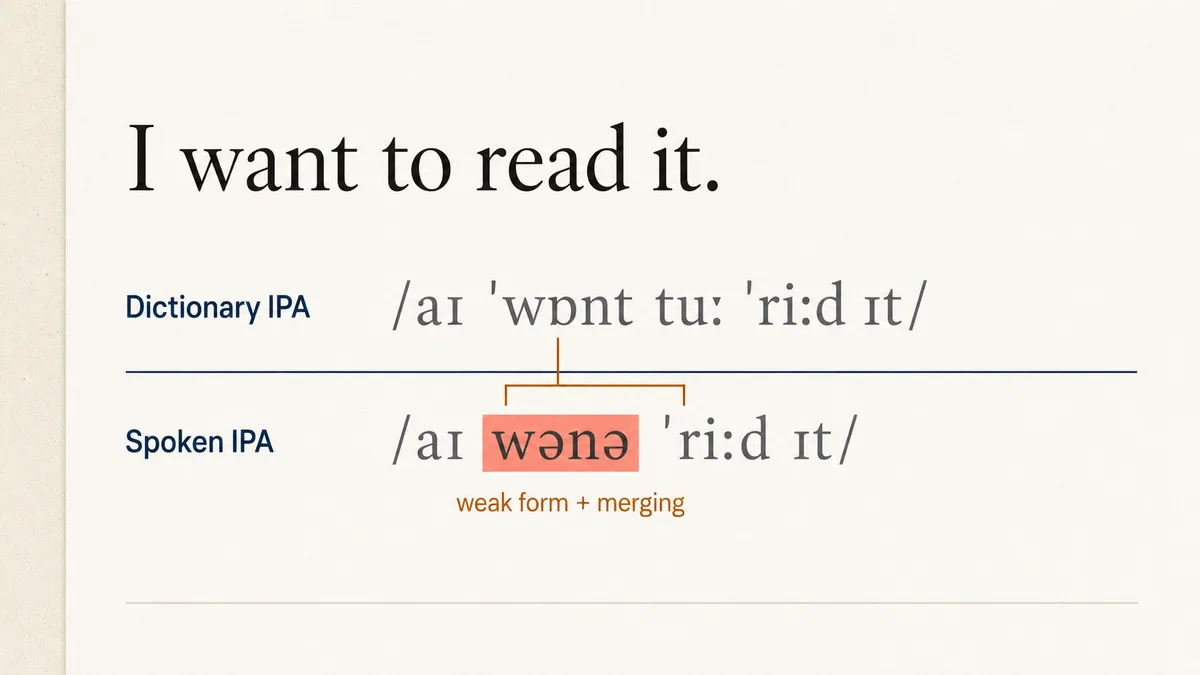
Reading each dictionary form in full can produce careful speech that differs from the reductions many speakers use in conversation.
Use this English to IPA translator to convert words, sentences, or paragraphs into IPA. Compare standard dictionary pronunciation with connected speech in American or British English.
See English and IPA line by line, including connected-speech changes.
Type or paste English text below.
Press Enter to transcribe, Shift+Enter for new line
Example — homograph pronunciation · US English
IPAtranslator turns English sentences into standard IPA and connected-speech IPA, so learners can compare dictionary forms with the weak forms, linking, and stress that can change in real speech.
A sentence can change how familiar words reduce, link, and sound together.
Reading each dictionary form in full can produce careful speech that differs from the reductions many speakers use in conversation.
Words such as to, and, can, and the may reduce or link differently depending on stress and the sounds around them.
"I read it yesterday" and "I read every day" use the same spelling, but read is pronounced differently in each sentence.
See the dictionary form, then examine how pronunciation can change in connected speech.
Connected speech is analyzed automatically: weak forms, linking, contraction merging, and unstressed-vowel reduction show you how words flow together.
AI uses the surrounding sentence to choose between known pronunciations for words such as "read", "lead", and "wind".
Switch between US and UK pronunciation without changing tools.
Start in the Spoken view, then select Show Original to compare the standard dictionary form with highlighted differences.
Go from English text to the Spoken and Original views in three steps.
Enter a word, sentence, or paragraph in the editor.
Choose American or British English, then generate the IPA transcription.
Select Show Original to view standard dictionary IPA and see highlighted differences.
Choose the approach that matches what you need to learn.
| Capability | IPAtranslator | Word-by-word IPA tools |
|---|---|---|
| Standard dictionary IPA | Yes — free, no account | Yes — often free |
| Connected speech with weak forms and linking | Yes — applied automatically | Usually not; words generally stay in dictionary form |
| Homograph disambiguation (read, lead, wind) | AI uses sentence context | Often manual selection or the first listed pronunciation |
| Spoken vs standard comparison view | Toggle between both, with differences highlighted | Varies by tool |
| American and British English | Yes | Often |
| Completely free with no credit system | Standard IPA is free; Spoken IPA uses IPA credits | Many are fully free |
If you only need isolated dictionary forms, our English to IPA converter covers that for free. This IPA translator adds a connected-speech view for studying how pronunciation can change across a sentence.
Paste English text into the IPA translator and compare the dictionary form with connected-speech pronunciation.
Try the IPA TranslatorIPAtranslator is an online IPA translator built to show more than isolated dictionary pronunciation. It lets you compare standard IPA with a connected-speech analysis of English.
A typical IPA translator returns one isolated pronunciation at a time. IPAtranslator also analyzes connected speech, applying weak forms, linking sounds across word boundaries, merging contractions, and reducing unstressed vowels when the context calls for them.
Some spellings have multiple pronunciations. For homographs such as "read", "lead", and "wind", IPAtranslator uses the surrounding sentence to choose between known pronunciations instead of asking you to select each form manually.
Switching between the Spoken and Original views reveals where vowels reduce, sounds link, or words merge. That comparison helps learners and teachers connect dictionary forms with pronunciation patterns found in connected speech.
IPAtranslator is designed for English learners, teachers, linguists, speech therapists, singers, voice actors, and developers who work with English pronunciation.
Built for
Start with 20 free IPA credits every day, then upgrade only when you need more. Standard IPA is always free and uses none.
Every plan includes the same IPAtranslator engine: Standard IPA, Spoken IPA, connected-speech analysis, weak forms, stress patterns, and AI homograph disambiguation. Plans differ by monthly Spoken IPA credit allowance, not by transcription features.
Spoken IPA uses 1 credit per processed segment. Short sentences may be combined, while longer text may split by punctuation and length, so the credit total can differ from the sentence count you entered.
Everything you need to know about IPA transcription and IPAtranslator.
Standard IPA is free. Try Spoken IPA with 10 free IPA credits — no account, no card needed.