10 Common English Pronunciation Mistakes and How to Fix Them
See 10 common pronunciation mistakes ESL learners make — th, r/l, v/w, and vowel swaps — with reference IPA, minimal pairs, and a fix for each.
These 10 pronunciation mistakes are among the most common reasons ESL learners sound unnatural in English. Each has a clear fix once you know exactly which sound to target.
You've corrected your "th" a hundred times in practice. Then it slips out wrong the moment you're mid-sentence in a real conversation. Learners who have studied English for years carry a handful of persistent errors like this into daily speech, and the reason is not lack of effort. It is that your brain has spent years mapping sounds onto the phonetic system of your native language, and English has several sounds that simply do not exist elsewhere. Until you can see and hear the difference precisely, your mouth defaults to the closest sound it already knows.
That is where the International Phonetic Alphabet becomes your most practical tool. IPA gives each sound its own symbol, so instead of guessing, you have a clear reference target. If you are new to IPA symbols, start with our beginner's guide to the IPA before working through this list. If you already know the basics, read on. Each mistake below comes with a reference IPA notation, a minimal pair to train your ear, and a practice tip you can use today.
Mistake 1: Confusing /ɪ/ (sit) and /iː/ (seat)
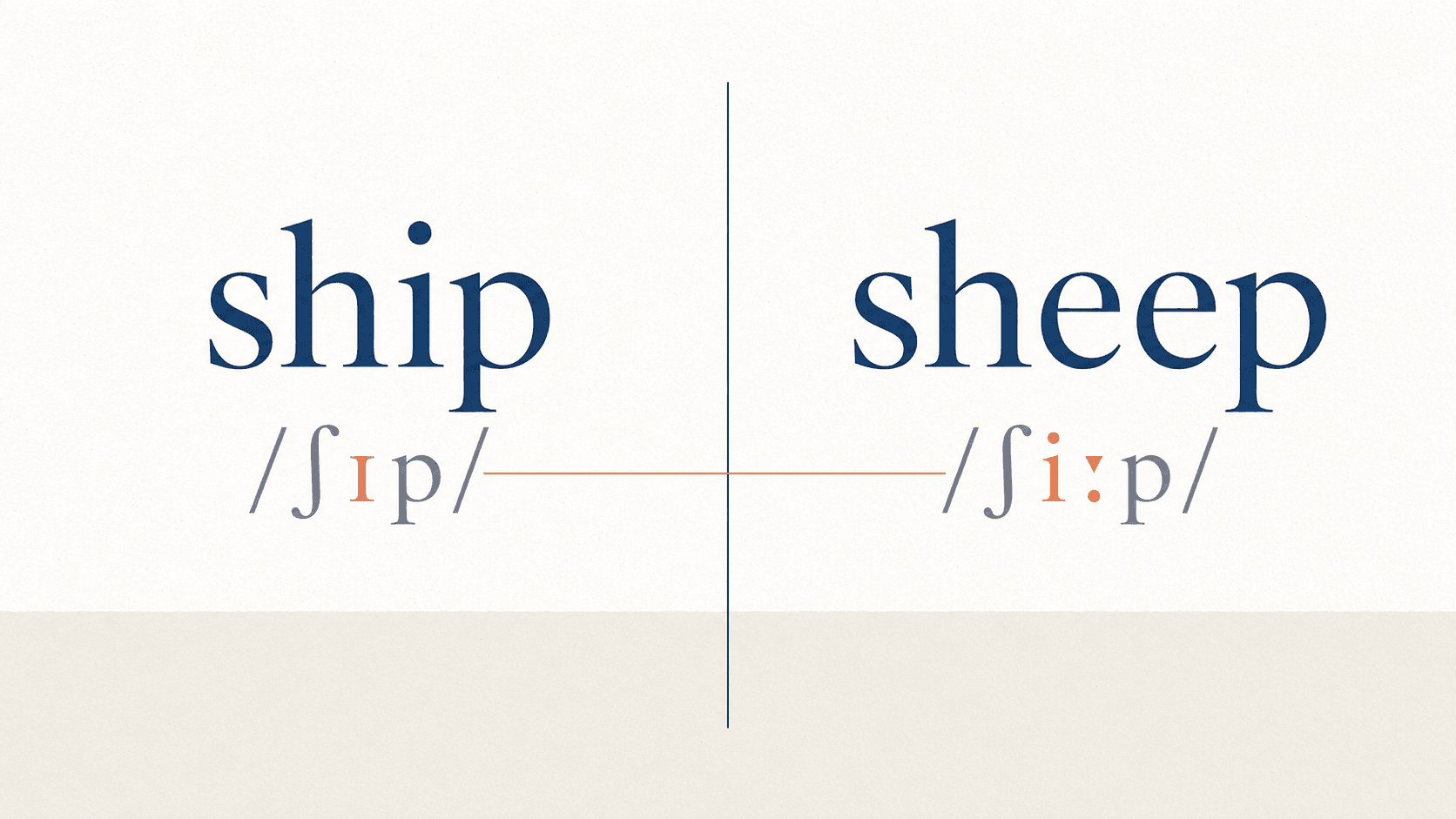
The mistake: Using the same vowel sound for both words, so "sit" and "seat" sound identical.
Why it happens: Many languages use a single high front vowel without distinguishing length or quality. Learners naturally map both English sounds onto that one familiar vowel.
The fix: These are not just different lengths of the same sound. They are genuinely different vowel qualities. For /ɪ/, your tongue is slightly lower and more relaxed. For /iː/, it is higher, tenser, and held longer.
| Minimal Pair | Wrong | Reference IPA |
|---|---|---|
| sit / seat | both sound like "seat" | /sɪt/ vs /siːt/ |
| ship / sheep | both sound like "sheep" | /ʃɪp/ vs /ʃiːp/ |
| fill / feel | both sound like "feel" | /fɪl/ vs /fiːl/ |
Practice tip: Say "sit" and let your jaw drop very slightly; that relaxed position is /ɪ/. Then say "seat" and pull the corners of your mouth back like a smile; that tension is /iː/. Alternate between the two until the muscle difference feels automatic.
Mistake 2: Pronouncing /θ/ (think) as /s/ or /t/
The mistake: Saying "sink" instead of "think," or "tink" instead of "think."
Why it happens: The sounds /θ/ (voiceless, as in "think") and /ð/ (voiced, as in "this") do not exist in most of the world's languages, including Spanish, French, Italian, German, Japanese, Mandarin, Arabic, and many others. Your brain replaces them with the nearest available sound.
The fix: Both /θ/ and /ð/ require you to place the tip of your tongue lightly between your upper and lower teeth (or just behind the upper teeth) and push air through. For /θ/ there is no voice; for /ð/ you add vibration.
| Minimal Pair | Wrong | Target IPA |
|---|---|---|
| think / sink | "sink" for "think" | /θɪŋk/ vs /sɪŋk/ |
| this / dis | "dis" for "this" | /ðɪs/ vs /dɪs/ |
| three / tree | "tree" for "three" | /θriː/ vs /triː/ |
Practice tip: Put your finger lightly against your lips and say "think." You should feel a tiny puff of air on your finger from the /θ/. If you feel nothing, your tongue is not in the right position. Practice slowly in front of a mirror until you can see your tongue tip between your teeth.
Mistake 3: Confusing /æ/ (cat) and /e/ or /ɑː/
The mistake: Saying "ket" or "kaht" instead of "cat."
Why it happens: The vowel /æ/, a low front vowel made with the mouth wide open and the tongue pushed forward, is genuinely rare across the world's languages. Most learners replace it with either the closer /e/ (as in "bed") or the more open /ɑː/ (as in "father").
The fix: For /æ/, open your mouth wide as if a doctor is checking your throat, push your tongue forward, and say the vowel. It should feel exaggerated at first.
| Minimal Pair | Wrong | IPA to Aim For |
|---|---|---|
| cat / ket | "ket" for "cat" | /kæt/ vs /kɛt/ |
| bad / bed | "bed" for "bad" | /bæd/ vs /bɛd/ |
| man / men | "men" for "man" | /mæn/ vs /mɛn/ |
Practice tip: Say the word "ah" (as in "father"), then try to move your tongue forward without closing your mouth. The resulting sound is very close to /æ/. Record yourself saying "cat, bat, hat" and compare to a native speaker recording.
Mistake 4: Dropping Word-Endings (-s and -ed)
The mistake: Saying "walk" for "walked," or "cat" for "cats."
Why it happens: Many languages do not use consonant clusters at the end of words, so learners unconsciously drop the final sounds to make words easier to say.
The fix: English past tense -ed and plural -s each have three possible pronunciations depending on the preceding sound, and IPA makes the rules visible:
Past tense -ed endings:
| Rule | When | Example | IPA |
|---|---|---|---|
| /t/ | after voiceless consonants | walked, stopped | /wɔːkt/, /stɒpt/ |
| /d/ | after voiced consonants and vowels | played, loved | /pleɪd/, /lʌvd/ |
| /ɪd/ | after /t/ or /d/ | wanted, needed | /ˈwɒntɪd/, /ˈniːdɪd/ |
Plural -s endings:
| Rule | When | Example | IPA |
|---|---|---|---|
| /s/ | after voiceless consonants | cats, books | /kæts/, /bʊks/ |
| /z/ | after voiced consonants and vowels | dogs, trees | /dɒɡz/, /triːz/ |
| /ɪz/ | after sibilant sounds | buses, watches | /ˈbʌsɪz/, /ˈwɒtʃɪz/ |
Practice tip: Read a short paragraph out loud and underline every -ed and -s ending before you start. Force yourself to pronounce each one. After two weeks of this, it becomes automatic.
Mistake 5: Mispronouncing /ʌ/ (cup, love, run)
The mistake: Saying /ɑː/ ("carp") or /ɒ/ ("cop") instead of /ʌ/ ("cup").
Why it happens: The vowel /ʌ/, a mid-central vowel, has no close equivalent in many languages. It is not quite "ah" and not quite "oh," which makes it easy to overshoot in either direction.
The fix: Relax your mouth completely into a neutral position, drop your jaw slightly, and let the sound come without any lip rounding. The key is no tension and no rounding.
| Minimal Pair | Wrong | Reference IPA |
|---|---|---|
| cup / cop | "cop" for "cup" | /kʌp/ vs /kɒp/ |
| love / larve | "larve" for "love" | /lʌv/ vs /lɑːv/ |
| run / ron | "ron" for "run" | /rʌn/ vs /rɒn/ |
Practice tip: Say the word "uh" as a hesitation sound (like when you're thinking). That neutral, effortless sound is almost exactly /ʌ/. Now build it into a word: "uh" → "cup."
Mistake 6: Not Using /ŋ/ (sing, ring, long)
The mistake: Saying "sin-g" (with a hard /g/ at the end) or "sin" (dropping the nasal entirely) instead of "sing."
Why it happens: Many learners treat "ng" as two separate letters and try to pronounce both, or they default to the familiar /n/ sound and drop the /g/ quality entirely.
The fix: The symbol /ŋ/ represents a single sound: a nasal consonant made at the back of the throat, not at the front like /n/. There is no /g/ sound after it in standard pronunciation of words like "sing," "ring," or "long."
| Minimal Pair | Wrong | Target IPA |
|---|---|---|
| sing / sin | "sin" for "sing" | /sɪŋ/ vs /sɪn/ |
| ring / rin | "rin" for "ring" | /rɪŋ/ vs /rɪn/ |
| long / lon | "lon" for "long" | /lɒŋ/ vs /lɒn/ |
Practice tip: Say "sing" and hold the final sound. You should feel vibration at the very back of your mouth, not behind your teeth. If you feel it at the front, you are making /n/, not /ŋ/.
Mistake 7: Confusing /v/ and /w/
The mistake: Saying "wery" for "very" or "vater" for "water."
Why it happens: Some languages, including German, Hindi, and several others, use a sound that sits between English /v/ and /w/, or they simply lack one of the two entirely.
The fix: The sounds are made in completely different parts of the mouth. For /v/, your upper teeth touch your lower lip and you push voiced air through the gap. For /w/, your lips round and come close together without any teeth contact. It is a pure lip sound.
| Minimal Pair | Wrong | IPA to Aim For |
|---|---|---|
| very / wery | "wery" for "very" | /ˈvɛri/ vs /ˈwɛri/ |
| vine / wine | "wine" for "vine" | /vaɪn/ vs /waɪn/ |
| vest / west | "west" for "vest" | /vɛst/ vs /wɛst/ |
Practice tip: For /v/, bite your lower lip gently and hum; that buzzing friction is /v/. For /w/, round your lips as if you are about to whistle, then say the vowel. Practice "vine / wine" ten times in a row, exaggerating the lip position for each.
Mistake 8: Flat Intonation
The mistake: Speaking every sentence with the same pitch level, making your English sound robotic or emotionless.
Why it happens: Learners concentrating on vocabulary and grammar often have no mental bandwidth left for pitch variation. Speakers of languages with fixed stress or very different intonation patterns also tend to transfer their native prosody into English.
The fix: English uses stress-timed rhythm: stressed syllables are louder, longer, and higher in pitch, while unstressed syllables are compressed. IPA stress marks show you exactly where to place emphasis: /ˈ/ marks primary stress and /ˌ/ marks secondary stress.
Compare these two sentences said with flat intonation versus natural stress:
- Flat: "I didn't say he stole the money."
- Natural: "I didn't say he stole the money." → /aɪ ˈdɪdnt seɪ hiː stəʊld ðə ˈmʌni/
The same sentence with stress on a different word changes meaning entirely, which is why intonation is not just stylistic. It is grammatically functional in English.
Practice tip: Choose one sentence per day and mark the stressed syllables before saying it. Record yourself, then compare to a native speaker. Apps that show pitch curves visually are especially helpful here.
For a deeper look at how stress and rhythm work in natural speech, see our guide to connected speech rules.
Mistake 9: Misplacing Stress in Multi-Syllable Words
The mistake: Saying /ˈfəʊtəɡrɑːfə/ (FOH-toh-gra-fer) instead of /fəˈtɒɡrəfə/ (fo-TOG-ra-fer) for "photographer."
Why it happens: English word stress is notoriously unpredictable; there is no simple rule that tells you which syllable to stress in every word. Learners often default to stressing the first syllable or the longest syllable.
The fix: Always check the IPA transcription of a new multi-syllable word and look for the /ˈ/ mark. It appears before the stressed syllable, not after it.
| Word | Common Error | Reference IPA |
|---|---|---|
| photographer | FOH-to-gra-fer | /fəˈtɒɡrəfə/ |
| information | IN-for-ma-tion | /ˌɪnfəˈmeɪʃən/ |
| comfortable | com-FOR-ta-ble | /ˈkʌmftəbəl/ |
| vegetable | ve-GE-ta-ble | /ˈvɛdʒtəbəl/ |
Practice tip: When you learn a new word, say the IPA transcription out loud before the word itself. This trains your brain to associate the word form with the correct stress pattern from the very first encounter.
Mistake 10: Pronouncing Every Letter
The mistake: Saying /ˈɪzlənd/ (iz-land) for "island," or /ˈlɪstən/ (lis-ten) for "listen."
Why it happens: English spelling is not phonetic. Dozens of common words contain silent letters that are written but never spoken, and beginners naturally try to pronounce what they see. This is one of the clearest cases where IPA is more reliable than spelling.
The fix: Trust the IPA, not the spelling. When a letter does not appear in the IPA transcription, it is silent.
| Word | Spelling Suggests | Reference IPA | Silent Letter |
|---|---|---|---|
| island | iz-land | /ˈaɪlənd/ | s |
| listen | lis-ten | /ˈlɪsən/ | t |
| know | k-now | /nəʊ/ | k |
| knight | k-nig-ht | /naɪt/ | k, gh |
| receipt | re-ceipt | /rɪˈsiːt/ | p |
| Wednesday | Wed-nes-day | /ˈwɛnzdeɪ/ | d |
Practice tip: Make a personal list of every word you have been mispronouncing because of its spelling. Look up each one in an IPA dictionary, write the transcription next to it, and practice saying the IPA version out loud. IPAtranslator lets you transcribe entire word lists at once, which makes this exercise much faster.
How IPA Transcription Tools Help You Identify Mistakes
Knowing about these ten mistakes is the first step. Actually hearing them in your own speech is the harder part. Most people cannot detect their own pronunciation errors because they hear what they intend to say, not what they actually say.
An IPA transcription tool bridges that gap. Paste any sentence you want to practice into IPAtranslator and you will see the full IPA transcription, including stress marks and connected speech reductions. Compare that transcription to how you have been saying the words. If you see /ɪ/ but you have been saying /iː/, you now have a precise target to fix.
The Spoken IPA mode goes one step further by showing you how words change in real, natural speech: where sounds link together, where vowels reduce to schwa, and where stress shifts in a sentence context. This is the level of detail that separates learners who sound "correct but stiff" from learners who sound genuinely natural. Pair the IPA display with the built-in audio playback so you can hear the target pronunciation immediately after seeing the symbols. If a particular word keeps tripping you up, our dedicated list of hard words to pronounce walks through the trickiest ones with their IPA and a fix for each.
Quick Reference Table
| # | Mistake | Wrong Sound | Reference IPA | Key Tip |
|---|---|---|---|---|
| 1 | /ɪ/ vs /iː/ | same vowel for both | /sɪt/ vs /siːt/ | Relax jaw for /ɪ/, tense lips for /iː/ |
| 2 | /θ/ and /ð/ | /s/, /t/, /d/ | /θɪŋk/, /ðɪs/ | Tongue between teeth |
| 3 | /æ/ | /e/ or /ɑː/ | /kæt/ | Open wide, push tongue forward |
| 4 | -ed and -s endings | dropped entirely | /wɔːkt/, /dɒɡz/ | Underline endings before reading aloud |
| 5 | /ʌ/ | /ɑː/ or /ɒ/ | /kʌp/ | Neutral mouth, no lip rounding |
| 6 | /ŋ/ | /n/ or /ng/ | /sɪŋ/ | Back of throat, no final /g/ |
| 7 | /v/ vs /w/ | interchanged | /ˈvɛri/ vs /ˈwɛri/ | Teeth on lip for /v/, rounded lips for /w/ |
| 8 | Flat intonation | uniform pitch | /ˈ/ and /ˌ/ marks | Stress = louder + longer + higher |
| 9 | Wrong word stress | first syllable default | /fəˈtɒɡrəfə/ | Always check /ˈ/ in IPA before learning a word |
| 10 | Silent letters | pronounce every letter | /ˈaɪlənd/, /ˈlɪsən/ | Trust IPA, not spelling |
Do not try to fix all ten mistakes at once. Pick the one that is most noticeable in your speech, work on it for two weeks until it feels natural, then move to the next. Steady, focused practice on one sound at a time is far more effective than scattered attention across all ten.
Frequently Asked Questions
Start with the mistake that causes the most misunderstandings in your daily conversations. For most learners, that is either the /θ/–/s/ confusion (Mistake 2) or word stress (Mistake 9), because these affect how native speakers parse what you are saying. If you are unsure which mistake is most prominent in your speech, record yourself speaking for two minutes and listen back. The errors that surprise you most are the ones to tackle first.
One of the most reliable methods is to record yourself and compare your pronunciation to a native speaker saying the same words. Alternatively, paste a sentence you commonly say into IPAtranslator, look at the IPA transcription, and ask yourself honestly whether that is what you have been producing. A language exchange partner or pronunciation coach can also give you direct feedback that self-monitoring cannot.
Not entirely, but they can replace a significant portion of what you would pay a teacher for. A good IPA tool provides a reference transcription and an audio model for self-study, on demand, which covers much of the reference function of a teacher. What a tool cannot do is listen to your actual speech and correct it in real time. For most learners, the best approach is to use an IPA tool daily for self-study and see a teacher or language partner occasionally for live feedback on specific persistent errors.
There is no fixed timeline. Progress varies with your starting point, your native language, practice quality, and how much feedback you get. Single targeted sounds tend to shift sooner than systemic habits like flat intonation or dropped word endings, which involve reprogramming rhythm patterns rather than a single articulation. The key variable is not time but deliberate repetition: passive listening alone rarely fixes a pronunciation habit that has been in place for years.
Conclusion
Pronunciation mistakes are not a character flaw. They are a predictable result of learning a language whose sound system differs from your own. Many of these mistakes have identifiable causes, and IPA gives you a clear reference target to work toward.
Pick one mistake from the table above, find ten words that contain that sound, and practice them out loud today. When you are ready to check your pronunciation against a reference IPA, head to IPAtranslator. Paste in a word, phrase, or full sentence to get an instant IPA transcription with audio playback: see the target and hear it at the same time. One sound at a time, your English will get clearer.
Author

Categories
More Posts
ChatGPT IPA Prompts for Connected Speech: What Works, What Fails
Copy-paste ChatGPT prompts for connected speech IPA — and the places AI output tends to go wrong. Three prompts plus a verification workflow.
Why Dictionaries Disagree on IPA: From Jones to Wells
Why do Oxford and Cambridge transcribe the same English word differently? Explore the history of IPA, the Jones-Gimson-Wells lineage, and the Upton debate.
40 Hard Words to Pronounce in English (With IPA and Fixes)
40 hard words to pronounce in English — with reference IPA (US), the reason each one trips people up, and a free tool to check each one yourself.
Newsletter
Join the community
Subscribe for English pronunciation tips and product updates