How to Pronounce "To" in English: Strong Form vs Weak Form
Learn how to pronounce "to" in English: strong form /tuː/, weak form /tə/, and the in-between /tʊ/ sound native speakers often use.
The word "to" has three common pronunciations: /tuː/ (strong form, used for emphasis), /tə/ (weak form, used in most connected speech), and /tʊ/ (a shortened form often heard before vowel sounds). Native speakers shift between all three depending on stress and context.
Type "to pronunciation" into a search bar and you'll get two answers: /tuː/ and /tə/. Open your mouth and say a full sentence out loud, though, and you'll often hear a third sound creep in — something shorter than /tuː/ but not quite the flat /tə/ either. If you've ever wondered which one is "correct," that question is exactly what this guide answers.
Here is a test you can run tonight: put on any American TV show, pick a scene of ordinary dialogue, and listen closely every time a character says "want to eat" or "going to work." Almost nobody produces a textbook /tə/. What you hear is closer to /tʊ/, especially before vowel sounds, and the pattern holds across different speakers and shows. That observation is the idea this guide is built around: the weak form of "to" isn't one fixed sound, it's a small range, and learning to recognize that range will improve your listening far more than memorizing a single symbol.
What Is the Strong Form of "To"?
The strong form of "to" is /tuː/, a full vowel sound and the version most learners meet first. It carries the full weight of the word and shows up in two main situations.
First, stress and emphasis. When "to" is contrasted with another word, it keeps its full vowel:
"Are you walking to the station, or from it?"
Second, isolation. When "to" stands alone, such as in answer to a question, the strong form is standard:
"Where are you headed?" "To the airport."
In ordinary connected speech, though, /tuː/ shows up far less often than learners expect. Listen to any stretch of casual conversation and track each "to" you hear: the strong form appears almost exclusively at the two moments described above, emphasis and isolation. Every other instance is reduced in some way. In running speech, reduction is the default and the strong form is the exception.
What Is the Weak Form of "To"? (The Schwa Sound)
The weak form, /tə/, is the pronunciation most pronunciation courses teach as the "default" version. The vowel reduces to schwa (/ə/), the short, neutral sound at the center of the mouth: the same vowel you hear in the first syllable of "sofa" or the last syllable of "banana."
Examples:
"I want tə go." "Nice tə meet you."
This reduction isn't random. English is a stress-timed language, which means stressed syllables fall at roughly regular intervals and unstressed syllables get squeezed in between them. Function words like "to," "for," "of," and "can" carry grammatical meaning but rarely carry new information, so they're often the first words to lose their full vowel.
| Word | Strong Form | Weak Form |
|---|---|---|
| to | /tuː/ | /tə/ |
| for | /fɔːr/ | /fə/ |
| of | /ɒv/ | /əv/ |
| can | /kæn/ | /kən/ |
The Three Pronunciations of "To": Strong, Weak, and In-Between
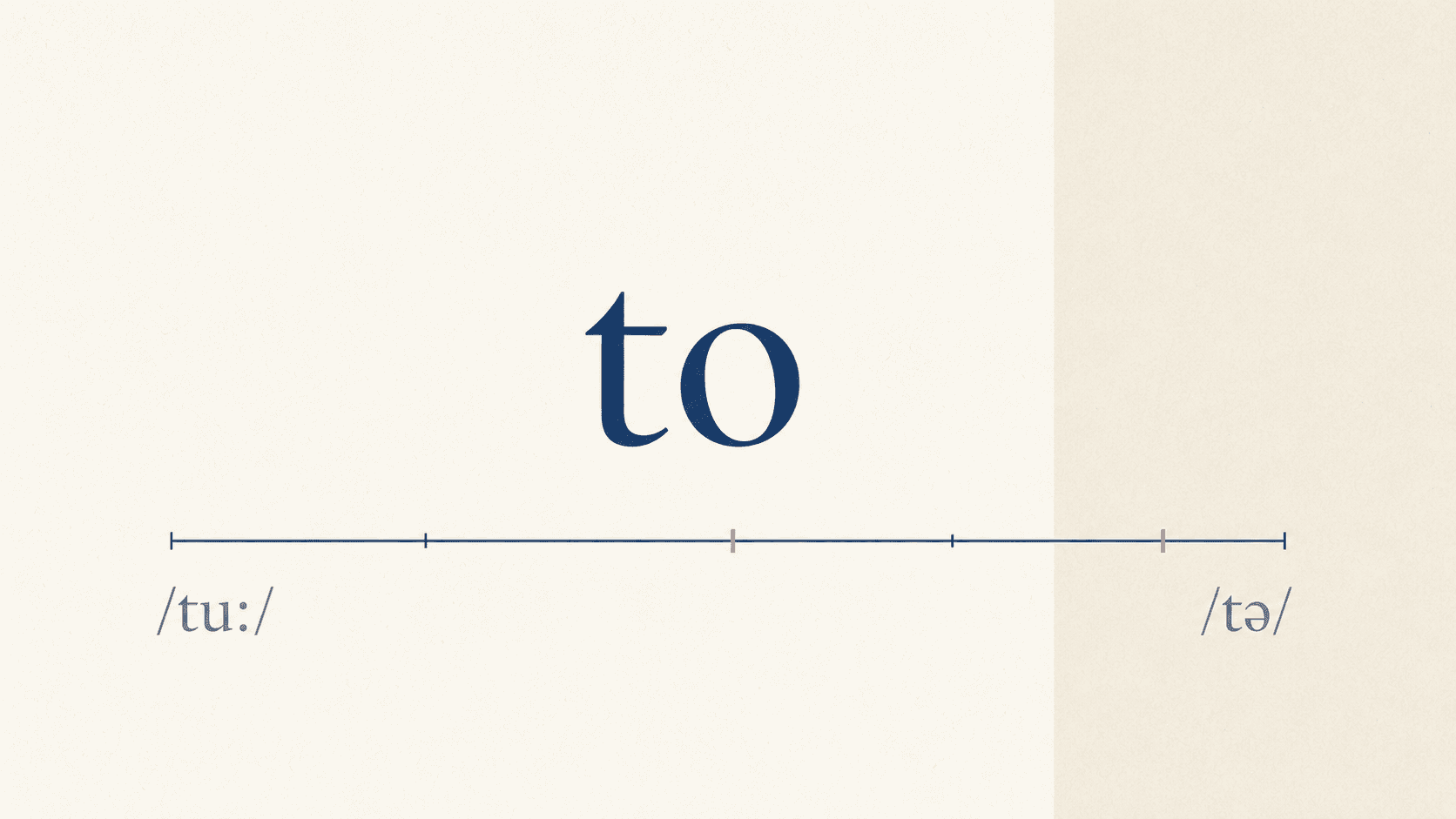
Try saying this sentence slowly: "I want to eat." Many courses would write that as "I want tə eat." But if you listen closely to native speakers, especially before words that start with a vowel, you'll often hear something closer to /tʊ/, shorter than /tuː/ but not as flat as /tə/.
This isn't a separate "rule" so much as a midpoint in a gradual process:
/tuː/ → /tʊ/ → /tə/
Full vowel, shortened vowel, fully centralized vowel. Speakers move along this scale depending on speed, emphasis, and what sounds come next, often without noticing they're doing it.
| Context | Typical Pronunciation |
|---|---|
| Spoken alone or for emphasis | /tuː/ |
| Before most consonants | /tə/ |
| Before vowel sounds (to eat, to ask) | /tʊ/ or /tə/ |
| Very slow, careful speech | /tuː/ |
This kind of gradual change is sometimes called vowel reduction, and "to" is one of the clearest everyday examples of it in English.
Why Dictionaries Only Show Two Forms of "To"
If dictionaries only listed /tuː/ and /tə/, you might assume those are the only two pronunciations that exist. In practice, dictionaries simply can't list every variation.
Speech is continuous and highly variable across speakers, accents, and speaking speeds. A dictionary entry, on the other hand, has to be a stable, teachable category. So most learner dictionaries pick two representative forms, the strong form and the weak form, and treat everything else as a rounding error.
This is closely tied to what linguists call connected speech: the way sounds shift, merge, and reduce when words are strung together in real sentences, rather than pronounced one at a time. The /tʊ/ pronunciation of "to" is a connected-speech phenomenon. It mostly shows up in the middle of phrases like "want to," "going to," or "got to," not when the word is said in isolation.
For learners, the takeaway isn't that dictionaries are wrong. A dictionary entry is a starting point, not a finish line. Once you've learned the strong and weak forms, the next step is training your ear for the in-between sounds that dictionaries don't have room for.
Does This Happen with Other Words Like "Do" and "You"?
Yes, and once you notice it for "to," you'll start hearing it everywhere. The same strong-to-weak progression shows up across many of the most common function words in English.
| Word | Reduction Pattern |
|---|---|
| to | /tuː/ → /tʊ/ → /tə/ |
| do | /duː/ → /dʊ/ → /də/ |
| you | /juː/ → /jʊ/ → /jə/ |
| for | /fɔːr/ → /fə/ |
The details differ slightly from word to word — do, you, and similar function words follow roughly the same arc, even if the exact midpoint sound varies by speaker. The underlying principle stays constant: words that appear constantly and carry little new information get shorter and less distinct over time.
How to Practice the Pronunciation of "To"
Recognizing these three forms is one thing. Producing them naturally, and hearing them in real speech, takes practice. Try this five-step approach:
- Nail the strong form first. Practice /tuː/ in isolation and in emphatic sentences ("I said to the left, not the right").
- Add the weak form in short phrases. Practice "want to," "going to," and "have to" using /tə/, keeping it light and short.
- Listen for /tʊ/ before vowels. Find 3-4 short clips of native speech containing phrases like "to eat," "to ask," or "to open," and listen specifically for the vowel quality.
- Practice full sentences, not single words. Reduction patterns only appear in connected speech, so isolated-word drills won't train your ear for them.
- Check your pronunciation against real audio. Tools like IPAtranslator can show you the phonetic transcription for full phrases, including which reduced form is most likely in a given context, so you can compare it directly to your own recording.
Most learners who follow this kind of listening-first approach report noticing weak forms in everyday speech within 1-2 weeks, even before their own pronunciation catches up.
Common Mistakes When Pronouncing "To"
Using /tuː/ in Every Sentence
This is the most common habit among learners, and it's easy to understand why: /tuː/ is the version taught first, so it feels like the "safe" choice. Using it everywhere isn't incorrect, but it makes speech sound noticeably formal (think of how a newsreader sounds compared to a friend chatting over coffee).
Reducing Every "To" to a Flat /tə/
The opposite mistake: applying /tə/ everywhere, including before vowel sounds where /tʊ/ is more natural. This usually isn't noticeable to listeners (it's a small difference), but it can make a learner's speech sound slightly mechanical once you're listening for it.
Practicing "To" as an Isolated Word
Weak forms exist because of connected speech, so drilling "to" by itself, over and over, won't build the skill. Whole phrases (to go, to eat, want to, going to) train your ear and mouth for the actual contexts where reduction happens.
Frequently Asked Questions
Both are correct, and which one you hear depends on stress. /tuː/ is the strong form, used when "to" is emphasized or stands alone, such as in "Where are you going? To London." /tə/ is the weak form, used constantly in connected speech when "to" carries no stress of its own.
Before a vowel sound, many speakers shorten "to" to something closer to /tʊ/ instead of the fully reduced /tə/. That's why "to eat" or "to ask" can sound slightly different from "to go" or "to dance." Both versions are normal, and the vowel quality simply shifts depending on the sound that follows.
No. Fast, casual speech often produces pronunciations that fall between /tuː/ and /tə/ rather than a textbook schwa. Speaking rate, the words before and after "to," and even regional accent all affect the exact vowel quality, so don't expect a single "correct" reduced form in every sentence.
Dictionaries need stable, teachable categories, so most list only the strong form /tuː/ and the weak form /tə/. Real speech is more variable than that: it includes intermediate sounds like /tʊ/ that aren't practical to list as separate dictionary entries, even though they're extremely common in everyday conversation.
Focus on the strong form /tuː/ and weak form /tə/ first, since those cover most situations and are what most courses teach (yes, even fluent-sounding learners often skip this step). As your listening improves, start noticing the shorter /tʊ/-like sound before vowels. You don't need to force it, but recognizing it will make native speech much easier to follow.
No, the strong form /tuː/ is always grammatically correct. The real issue is naturalness: using /tuː/ in every single instance of "to," even when the word carries no stress, can make fluent speech sound overly careful. Save it for emphasis, contrast, or when "to" stands alone at the end of a sentence.
Conclusion: Making "To" Sound Natural
The pronunciation of "to" isn't a two-way choice between /tuː/ and /tə/. It's a short scale, from a full vowel, to a shortened vowel, to a fully reduced schwa, and native speakers move along that scale constantly without thinking about it.
To recap: use the strong form /tuː/ for emphasis and isolation, use the weak form /tə/ for most connected speech, and start listening for the /tʊ/-like sound before vowels once the first two feel automatic.
If you want to see how "to" and other function words reduce in real phrases, try IPAtranslator: type any sentence and get a phonetic transcription that reflects natural connected speech, not just the dictionary-standard forms. And if you'd like the bigger picture of why English works this way, our in-depth guide to connected speech walks through the system behind reductions like this one across the whole language. For more practice with related sounds, our beginner's guide to the IPA is a good next stop.
Author

Categories
More Posts
ChatGPT IPA Prompts for Connected Speech: What Works, What Fails
Copy-paste ChatGPT prompts for connected speech IPA — and the places AI output tends to go wrong. Three prompts plus a verification workflow.
40 Hard Words to Pronounce in English (With IPA and Fixes)
40 hard words to pronounce in English — with reference IPA (US), the reason each one trips people up, and a free tool to check each one yourself.
Daily Pronunciation Practice with IPA and TTS: A 5-Step Method
A 5-step daily pronunciation practice method using IPA and TTS audio — with 15–25 minute routines for beginner, intermediate, and advanced learners.
Newsletter
Join the community
Subscribe for English pronunciation tips and product updates